Recyclable Elastic Yarn: A New Chapter in Sustainable Stretchwear
We’ve gotten pretty great at making clothes perform miracles—stretching through squats, wicking sweat, and somehow making us feel athletic even when we’re just running errands. But giving those clothes a second life is a whole different game. Worn-out gear is often burned, downcycled, or tossed into landfills. Much of that stretchy magic comes from spandex, usually teamed up with polyester or nylon. Great for your performance, not so great for recycling. So, eco-minded innovators are turning their attention to one critical challenge: can elastic yarns be designed to stretch well and still make it back into the material cycle?
When we picture plastic pollution, we usually think of water bottles, grocery bags, coffee lids, bubble wrap, and takeout containers. But a huge part of the problem is quietly hiding in our closets.
Yes, textiles are part of the plastic pollution story too. A Nature Communications study estimated that the apparel industry generated a staggering 8.3 million tonnes of plastic pollution in 2019—mostly driven by synthetic materials and stretchy blends like polyester and spandex. Once locked into a blend, these fibres are a nightmare to untangle—leaving worn-out gear to sit in landfills for decades or undergo costly, complex chemical processing just to be recycled, consuming massive amounts of energy, creating chemical runoff, and generating a whole new wave of toxic waste.
The Story of Recyclable Elastic Yarn
For a long time, the journey of elastic yarn was pretty simple: make it, wear it, stretch it, and eventually throw it away. Now, researchers are asking a rather useful question: what if we could make the yarn again? New approaches are exploring how elastic materials can be recovered, remade and put back into circulation.
Bring Recycled Fibres Into The Yarn Itself
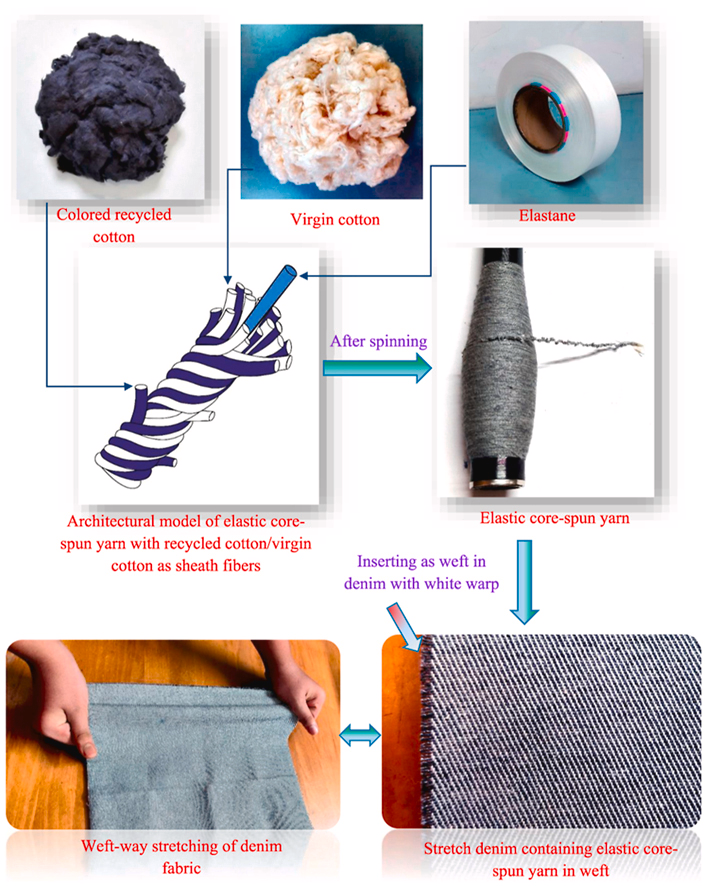
In a 2024 study, researchers recovered cotton from pre-consumer fabric waste and blended it with virgin cotton to make elastic core-spun yarn for stretch denim. They were able to use up to 60% recycled cotton while still producing yarn suitable for denim weaving. When woven into denim, even the 60% recycled-cotton version produced a smooth, balanced-looking fabric that was difficult to distinguish visually from denim made with conventional yarn.
While this doesn’t make the elastic yarn itself recyclable, it does reduce the need for virgin cotton and gives textile waste another use before it becomes waste again.
Source: PubMed Central
Rethink The Stretchy Component
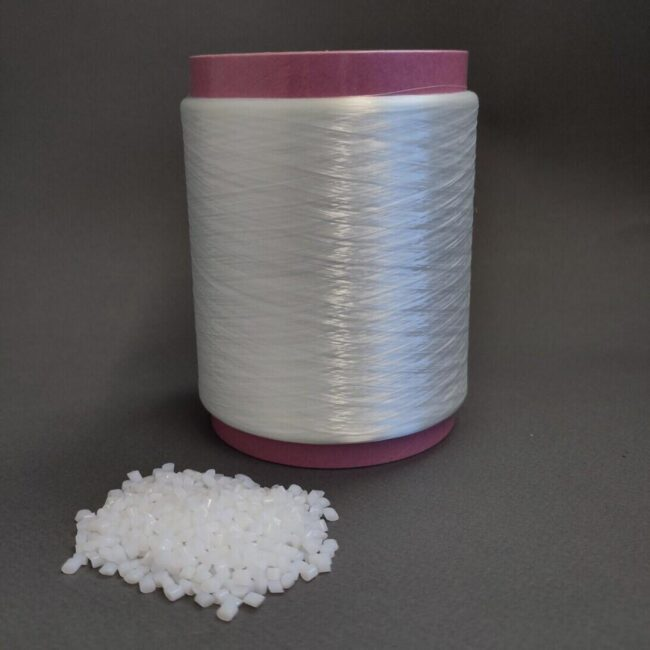
Researchers at RWTH Aachen University are looking at thermoplastic copolyester elastomers, or TPCs, as an alternative to conventional elastane. Unlike conventional elastane, TPCs can be melted and reshaped, which means they can potentially go through recycling with polyester rather than becoming the awkward bit that needs to be dealt with separately.
Researchers have already tested different polyester-TPC blends and successfully spun them into yarn at both laboratory and pilot scale. And because they’re produced using a solvent-free melt-spinning process, no toxic chemicals are required just to get that perfect snap back.
Source: Indian Textile Journal
Eliminating Mixed Materials Completely – Fully Recyclable Yarn
MIT engineers have cracked the code using a material you probably encounter every day—polyethylene. By combining two distinct forms of the same polymer into one yarn (a stretchy core wrapped in a structural sheath), they created an elastic thread that behaves like spandex but can go back into the melt-and-remake cycle. No chemical disentangling required—just melt it down and spin it right back into brand-new yarn or plastic items like buttons and belt buckles.
By skipping mixed blends entirely, it eliminates the need for toxic chemical separation while keeping processing emissions remarkably low. Even after ten consecutive melt-and-respin cycles, the material retains its strength, meaning old activewear can be reborn as fresh yarn over and over without degrading in quality.
Weighing in on the development, Ramesh Menon sees innovations like MIT’s as a step towards making circularity a more practical part of textile manufacturing—not just a sustainability goal on paper.

Source: MIT News
Understand the Circular Hierarchy
Source: AI-generated Image
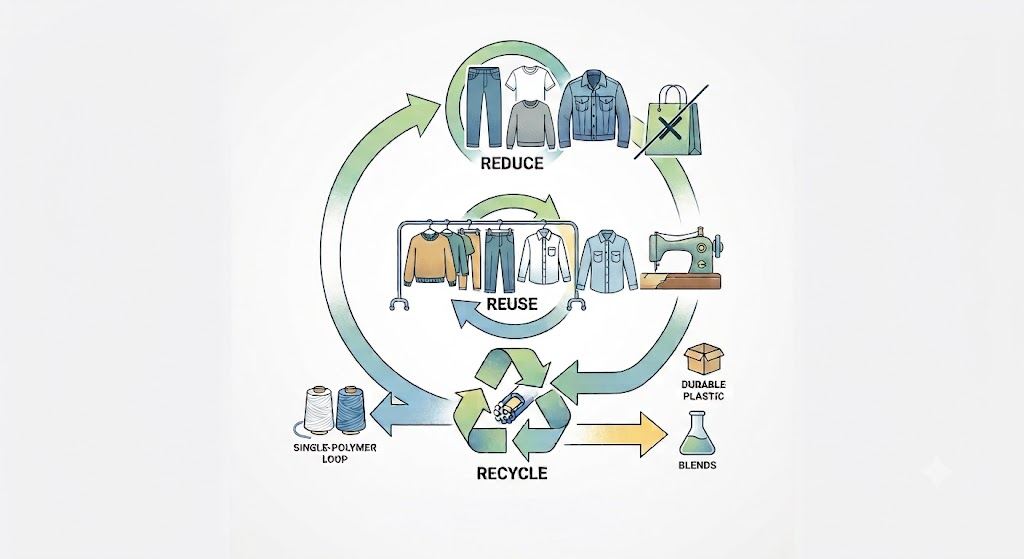
There’s a reason the hierarchy goes reduce, reuse, then recycle. Recycling isn’t a free pass to keep consuming; it’s what comes after we’ve made the most of a product.
- Reducing is the ultimate flex: making fewer, better clothes that consume less resources so we aren’t drowning in landfill-bound impulse buys.
- Reusing keeps the story going. Swapping outfits for discounts, mending and repairing kiosks, or thrift stores keeps well-loved apparel doing what it does best—staying on backs instead of taking up landfill space.
- Recycling is the last resort because keeping a product in use is generally better than breaking it down and starting again. But it needs prep: if we want old leggings reborn as new yarn tomorrow, they have to be built smart today.
Recycling may be what happens at the end, but the decisions that make it possible need to happen much earlier.
Circularity Starts at the Beginning
Here’s what we’re taking away from all this: recycling shouldn’t be an afterthought. If we want clothes to have a second life, we need to think about that second life while designing the first one.
From recycled fibres to recyclable elastomers and yarns designed to be melted and remade, researchers are exploring different answers. None of them is a silver bullet—and some are still very much in the research stage—but together, they point towards a more circular way of making clothes.
Because circular fashion shouldn’t be about making better excuses for what happens to old clothes, it should be about making better materials in the first place. And honestly, we think that’s a much better stretch for fashion: make it well, wear it well, and give it a plan for what comes next.
Know someone working on recyclable textiles, circular fashion, or smart material innovations? Tell us in the comments below or share this with them. Let’s give the people rethinking fashion to make it circular the spotlight they deserve.
References:
- https://www.thecirculateinitiative.org/blog/hiding-in-plain-sight-the-apparel-industrys-contribution-to-plastic-pollution/
- https://pmc.ncbi.nlm.nih.gov/articles/PMC10875377/
- https://indiantextilejournal.com/elastic-yarns-to-become-greener-and-more-recyclable/
- https://news.mit.edu/2026/mit-engineers-design-recyclable-elastic-yarn-0727
- https://www.ita.rwth-aachen.de/cms/ita/das-institut/aktuelle-meldungen/~brbrek/kleine-toleranzen-grosse-wirkung-und-re/?lidx=1