
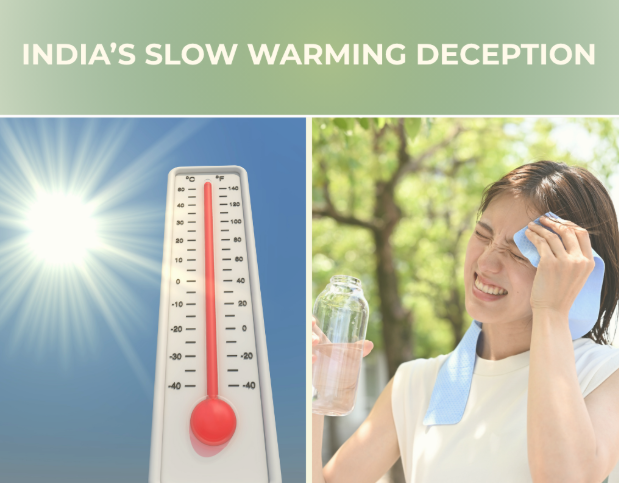
India’s Slow Warming Deception: Unmasking the Truth About Heat
There is a rather comforting climate statistic doing the rounds: India is warming more slowly than the world. Between 1901–1930 and 2015–2024, India’s average temperature increased by around 0.89°C, compared with approximately 1.42°C warming over global land areas during a comparable period.
Sounds reassuring.
Until you discover that 2024 was still India’s warmest year since records began in 1901, with the annual mean temperature 0.65°C above the 1991–2020 average. A lower rate of warming offers little comfort when the baseline itself is already shifting.
Because an annual average does not make a worker sweat less on a 45°C afternoon!
The “GOOD-NEWS” That Needs a Very Large Asterisk
Scientists have observed a phenomenon sometimes described as a “warming hole” over parts of India, referring to relatively slower surface warming compared with broader global trends. Research suggests that aerosols, irrigation, land-use changes, monsoon behaviour and atmospheric circulation may all contribute to this pattern.
The important word is may.
There is no single explanation that makes India climate-proof, and some factors associated with reduced surface warming bring their own environmental consequences. Aerosols can influence solar radiation and monsoon processes, while land-use changes can alter evapotranspiration and rainfall patterns.
That creates the first climate paradox: a factor that suppresses one form of warming is not automatically something we want more of.
Climate systems, inconveniently, do not come with a simple good-news/bad-news toggle.
Cooler On Paper. Hotter Where It Actually Matters.
This is where averages become dangerously comforting. A country can experience moderate average warming while still seeing more frequent, intense or prolonged extreme heat, with research showing increases in warm days and heatwave characteristics across many parts of India.
Humidity makes the problem worse because it reduces the body’s ability to release heat. The International Labour Organization identifies excessive heat as an occupational safety risk capable of causing illness, heatstroke and, in severe cases, death.
Those most exposed often have the least escape: construction workers, farm labourers, sanitation workers and delivery personnel. And a business with an air-conditioned headquarters is hardly immune.
Your Business Has a Heat Problem. Your P&L Just Hasn’t Named It Yet!
Climate risk often arrives wearing a familiar uniform: carbon emissions, ESG reporting and net-zero targets. But heat is quietly showing up in electricity bills, productivity, worker safety and disrupted operations.
Heat is becoming an operations problem.
The World Bank estimates that around 75% of India’s workforce, or approximately 380 million people, is exposed to heat-related labour risks. It also cites research estimating that more than 101 billion hours of heavy-labour work are lost annually in India because of heat exposure.
For businesses, that means:
- slower shifts
- delayed construction
- disrupted deliveries
- higher refrigeration costs
- greater pressure on workers
None of these line items may say “climate change” on the invoice. But it is there anyway, and your sustainability agenda? starts looking suspiciously like operations management.

THEN COMES THE AC. BECAUSE APPARENTLY EVERY CLIMATE PROBLEM NEEDS ANOTHER POWER BILL.
The most obvious response to rising heat is cooling. More air conditioning and refrigeration can protect people and keep businesses functioning, but they also increase electricity demand.
That creates the cooling paradox.
The IEA estimates that heatwaves in India in 2024 drove additional fossil-fuel use for electricity generation, resulting in around 50 million tonnes of additional CO₂ emissions. It also estimates that cooling accounted for around 15% of India’s electricity demand growth between 2021 and 2025.
More heat means more cooling, more electricity demand and potentially more emissions, further fuelling the warming that drives cooling demand.
So the answer cannot simply be “install another AC.” That is the climate equivalent of putting a larger bucket under a leaking roof and calling it infrastructure.
The Warming Hole Is Not a Climate Insurance Policy.
India’s historical warming pattern should not be mistaken for protection from future warming. A recent analysis projects another 1.2–1.3°C of warming over India by mid-century under an intermediate emissions scenario relative to 1995–2014, alongside increases in heatwave frequency and duration.
That changes the question businesses should be asking.
Not simply, “How much will temperatures rise?” but “What happens to our operations when extreme heat becomes more frequent?”
Businesses operate on factory shifts, delivery schedules, agricultural cycles, warehouse inventories and construction timelines. They operate on thresholds, not averages.
An annual temperature report cannot tell a factory manager what happens when workers cannot safely maintain normal output at 2 PM. That is where climate stops being a statistic and starts becoming a business interruption.

Stop Measuring Only Carbon. Start Measuring The Heat Bill.
Climate action for businesses needs adaptation alongside mitigation. One useful starting point is a “Heat P&L”: an internal view of what extreme heat actually costs through cooling, productivity losses, absenteeism, spoilage, downtime and delayed operations.
Businesses can turn that information into practical action:
- Measure heat stress, not temperature alone. Track humidity, exposure and workload.
- Design for heat. Use shading, insulation, ventilation and efficient cooling.
- Adapt operating hours. Schedule outdoor and intensive work around extreme heat.
- Set heat thresholds. Build clear responses into continuity plans.
- Protect workers without cooling. Extend heat resilience to sites, roads, farms and warehouses.
The goal is not to make everyone feel guilty for switching on the AC. It is to stop treating the AC as our only climate adaptation strategy.

The Green Pistachio Take: The Climate Doesn’t Care About Your Annual Average.
India may be warming more slowly than the global average, but that does not make climate risk somebody else’s problem. A lower average can still mean dangerous heatwaves, rising cooling demand and lost productivity.
For businesses, climate readiness needs to move into everyday operations. The question is whether your business can keep operating when the hottest days become harder to ignore.
If your business cannot tell you what extreme heat costs, can it really say it is prepared for climate change? Find out before the weather does it for you.